Web tools can turn the world upside down. Change.org has empowered ordinary people to close down homophobic “clinics” in Ecuador, shine a light on sex trafficking, and force banks to drop fees.
Sunday, February 5, 2012


Friday, February 3, 2012
prank image
(Reuters) - Inmates working at a Vermont correctional unit's print shop managed to sneak a prank image of a pig into a state police crest that is emblazoned on police cars, and 30 cruisers sported the design for the last year, officials said on Thursday.
The official crest depicts a spotted cow against a background of snowy mountains, but the inmates' version featured one of the cow's spots shaped like a pig in an apparent reference to the pejorative word for police, state police spokeswoman Stephanie Dasaro said.
"It dishonors the memory of those past and present members, especially for those who have lost their lives in the line of duty," Dasaro said.
Vermont contracts with correctional facilities employing prisoners to make some print products, including the cruiser decals. Police said someone who works at the print shop changed the emblem from the officially sanctioned design.
A police employee noticed the prank on Wednesday and reported it. Police said the 60 16-inch door decals would be removed as soon as it was practical.
The "source and timing" of the change to the design is under investigation, Dasaro said.
"While some may find humor in the decal modifications, the joke unfortunately comes at the expense of the taxpayers," Police Major Bill Sheets said in a statement.
(Editing By Ellen Wulfhorst and Cynthia Johnston)
no-fly list
The Associated Press is reporting the Obama administration has more than doubled the number of people on the secret no-fly list who are prevented from flying to or within the United States. The government broadened the criteria for the list, which now has about 21,000 names, including some 500 Americans. The American Civil Liberties Union has sued the government on behalf of Americans who believe they have been unfairly prevented from travel.
Wednesday, February 1, 2012
To My Old Master, Colonel P. H. Anderson
Letters of Note is an attempt to gather and sort fascinating letters, postcards, telegrams, faxes, and memos. Scans/photos where possible. Fakes will be sneered at. Updated as often as possible; usually each weekday.
Source: The Freedmen's Book;
In August of 1865, a Colonel P.H. Anderson of Big Spring, Tennessee, wrote to his former slave, Jourdan Anderson, and requested that he come back to work on his farm. Jourdan — who, since being emancipated, had moved to Ohio, found paid work, and was now supporting his family — responded spectacularly by way of the letter seen below (a letter which, according to newspapers at the time, he dictated).
Dayton, Ohio,
August 7, 1865
To My Old Master, Colonel P. H. Anderson,
Big Spring, Tennessee
Sir:
I got your letter, and was glad to find that you had not forgotten Jourdon, and that you wanted me to come back and live with you again, promising to do better for me than anybody else can. I have often felt uneasy about you. I thought the Yankees would have hung you long before this, for harboring Rebs they found at your house. I suppose they never heard about your going to Colonel Martin's to kill the Union soldier that was left by his company in their stable. Although you shot at me twice before I left you, I did not want to hear of your being hurt, and am glad you are still living. It would do me good to go back to the dear old home again, and see Miss Mary and Miss Martha and Allen, Esther, Green, and Lee. Give my love to them all, and tell them I hope we will meet in the better world, if not in this. I would have gone back to see you all when I was working in the Nashville Hospital, but one of the neighbors told me that Henry intended to shoot me if he ever got a chance.
I want to know particularly what the good chance is you propose to give me. I am doing tolerably well here. I get twenty-five dollars a month, with victuals and clothing; have a comfortable home for Mandy,—the folks call her Mrs. Anderson,—and the children—Milly, Jane, and Grundy—go to school and are learning well. The teacher says Grundy has a head for a preacher. They go to Sunday school, and Mandy and me attend church regularly. We are kindly treated. Sometimes we overhear others saying, "Them colored people were slaves" down in Tennessee. The children feel hurt when they hear such remarks; but I tell them it was no disgrace in Tennessee to belong to Colonel Anderson. Many darkeys would have been proud, as I used to be, to call you master. Now if you will write and say what wages you will give me, I will be better able to decide whether it would be to my advantage to move back again.
As to my freedom, which you say I can have, there is nothing to be gained on that score, as I got my free papers in 1864 from the Provost-Marshal-General of the Department of Nashville. Mandy says she would be afraid to go back without some proof that you were disposed to treat us justly and kindly; and we have concluded to test your sincerity by asking you to send us our wages for the time we served you. This will make us forget and forgive old scores, and rely on your justice and friendship in the future. I served you faithfully for thirty-two years, and Mandy twenty years. At twenty-five dollars a month for me, and two dollars a week for Mandy, our earnings would amount to eleven thousand six hundred and eighty dollars. Add to this the interest for the time our wages have been kept back, and deduct what you paid for our clothing, and three doctor's visits to me, and pulling a tooth for Mandy, and the balance will show what we are in justice entitled to. Please send the money by Adams's Express, in care of V. Winters, Esq., Dayton, Ohio. If you fail to pay us for faithful labors in the past, we can have little faith in your promises in the future. We trust the good Maker has opened your eyes to the wrongs which you and your fathers have done to me and my fathers, in making us toil for you for generations without recompense. Here I draw my wages every Saturday night; but in Tennessee there was never any pay-day for the negroes any more than for the horses and cows. Surely there will be a day of reckoning for those who defraud the laborer of his hire.
In answering this letter, please state if there would be any safety for my Milly and Jane, who are now grown up, and both good-looking girls. You know how it was with poor Matilda and Catherine. I would rather stay here and starve—and die, if it come to that—than have my girls brought to shame by the violence and wickedness of their young masters. You will also please state if there has been any schools opened for the colored children in your neighborhood. The great desire of my life now is to give my children an education, and have them form virtuous habits.
Say howdy to George Carter, and thank him for taking the pistol from you when you were shooting at me.
From your old servant,
Jourdon Anderson.
Source: The Freedmen's Book;
In August of 1865, a Colonel P.H. Anderson of Big Spring, Tennessee, wrote to his former slave, Jourdan Anderson, and requested that he come back to work on his farm. Jourdan — who, since being emancipated, had moved to Ohio, found paid work, and was now supporting his family — responded spectacularly by way of the letter seen below (a letter which, according to newspapers at the time, he dictated).
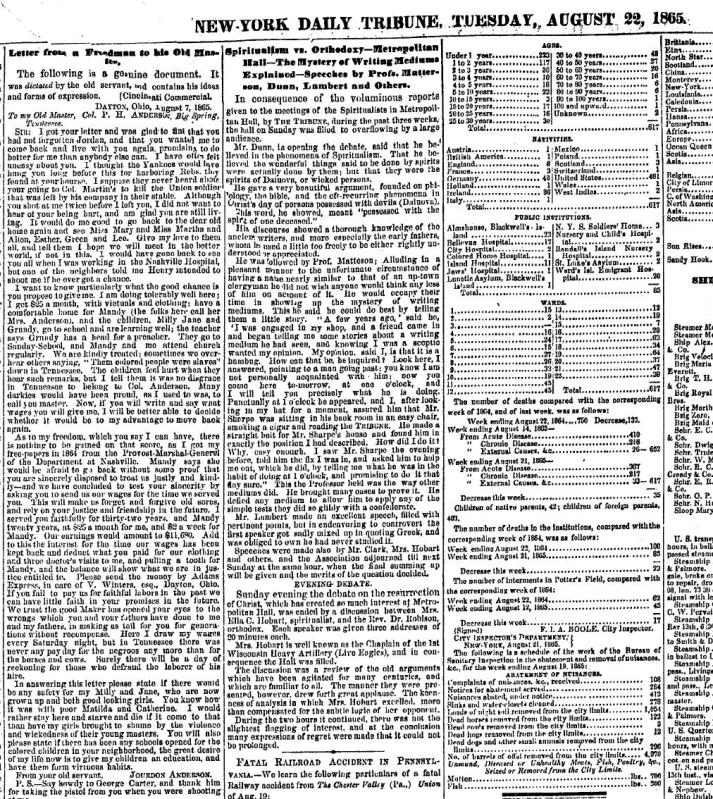
Dayton, Ohio,
August 7, 1865
To My Old Master, Colonel P. H. Anderson,
Big Spring, Tennessee
Sir:
I got your letter, and was glad to find that you had not forgotten Jourdon, and that you wanted me to come back and live with you again, promising to do better for me than anybody else can. I have often felt uneasy about you. I thought the Yankees would have hung you long before this, for harboring Rebs they found at your house. I suppose they never heard about your going to Colonel Martin's to kill the Union soldier that was left by his company in their stable. Although you shot at me twice before I left you, I did not want to hear of your being hurt, and am glad you are still living. It would do me good to go back to the dear old home again, and see Miss Mary and Miss Martha and Allen, Esther, Green, and Lee. Give my love to them all, and tell them I hope we will meet in the better world, if not in this. I would have gone back to see you all when I was working in the Nashville Hospital, but one of the neighbors told me that Henry intended to shoot me if he ever got a chance.
I want to know particularly what the good chance is you propose to give me. I am doing tolerably well here. I get twenty-five dollars a month, with victuals and clothing; have a comfortable home for Mandy,—the folks call her Mrs. Anderson,—and the children—Milly, Jane, and Grundy—go to school and are learning well. The teacher says Grundy has a head for a preacher. They go to Sunday school, and Mandy and me attend church regularly. We are kindly treated. Sometimes we overhear others saying, "Them colored people were slaves" down in Tennessee. The children feel hurt when they hear such remarks; but I tell them it was no disgrace in Tennessee to belong to Colonel Anderson. Many darkeys would have been proud, as I used to be, to call you master. Now if you will write and say what wages you will give me, I will be better able to decide whether it would be to my advantage to move back again.
As to my freedom, which you say I can have, there is nothing to be gained on that score, as I got my free papers in 1864 from the Provost-Marshal-General of the Department of Nashville. Mandy says she would be afraid to go back without some proof that you were disposed to treat us justly and kindly; and we have concluded to test your sincerity by asking you to send us our wages for the time we served you. This will make us forget and forgive old scores, and rely on your justice and friendship in the future. I served you faithfully for thirty-two years, and Mandy twenty years. At twenty-five dollars a month for me, and two dollars a week for Mandy, our earnings would amount to eleven thousand six hundred and eighty dollars. Add to this the interest for the time our wages have been kept back, and deduct what you paid for our clothing, and three doctor's visits to me, and pulling a tooth for Mandy, and the balance will show what we are in justice entitled to. Please send the money by Adams's Express, in care of V. Winters, Esq., Dayton, Ohio. If you fail to pay us for faithful labors in the past, we can have little faith in your promises in the future. We trust the good Maker has opened your eyes to the wrongs which you and your fathers have done to me and my fathers, in making us toil for you for generations without recompense. Here I draw my wages every Saturday night; but in Tennessee there was never any pay-day for the negroes any more than for the horses and cows. Surely there will be a day of reckoning for those who defraud the laborer of his hire.
In answering this letter, please state if there would be any safety for my Milly and Jane, who are now grown up, and both good-looking girls. You know how it was with poor Matilda and Catherine. I would rather stay here and starve—and die, if it come to that—than have my girls brought to shame by the violence and wickedness of their young masters. You will also please state if there has been any schools opened for the colored children in your neighborhood. The great desire of my life now is to give my children an education, and have them form virtuous habits.
Say howdy to George Carter, and thank him for taking the pistol from you when you were shooting at me.
From your old servant,
Jourdon Anderson.
Sunday, January 22, 2012
looking for trouble
WASHINGTON (Reuters) - A U.S. aircraft carrier sailed through the Strait of Hormuz and into the Gulf without incident on Sunday, a day after Iran backed away from an earlier threat to take action if an American carrier returned to the strategic waterway.
The carrier USS Abraham Lincoln completed a "regular and routine" passage through the strait, a critical gateway for the region's oil exports, "as previously scheduled and without incident," said Lieutenant Rebecca Rebarich, a spokeswoman for the U.S. Fifth Fleet.
The Lincoln, accompanied by strike group of warships, was the first U.S. aircraft carrier to enter the Gulf since late December and was on a routine rotation to replace the outgoing USS John C. Stennis.
The departure of the Stennis prompted Iranian army chief Ataollah Salehi to threaten action if the carrier passed back into the Gulf.
"I recommend and emphasize to the American carrier not to return to the Persian Gulf. ... We are not in the habit of warning more than once," he said.
The threat led to a round of escalating rhetoric between the two sides that spooked oil markets and raised the specter of a military confrontation between Iran and the United States.
Iran threatened to close the strait, the world's most important oil shipping gateway, while the United States warned such a move would require a response by Washington, which routinely patrols international sea lanes to ensure they remain open.
Iran appeared to ease away from its earlier warnings on Saturday, with Revolutionary Guard Corps Deputy Commander Hossein Salami telling the official IRNA news agency that the return of U.S. warships to the Gulf was routine and not an increase in its permanent presence in the region.
"U.S. warships and military forces have been in the Persian Gulf and the Middle East region for many years and their decision in relation to the dispatch of a new warship is not a new issue and it should be interpreted as part of their permanent presence," Salami said.
Pentagon officials declined to comment directly on Salami's remarks, but reiterated that continued U.S. presence in the region reflected the seriousness with which Washington takes its security commitments to partner nations in the region and to ensuring free flow of international commerce.
The Lincoln's arrival in the Gulf was unrelated to Iran's statement on Saturday.
Tensions between Iran and the United States have been escalating in recent weeks as President Barack Obama prepares to implement new U.S. sanctions against Iran over its nuclear enrichment program, which Tehran says is for energy production but the West believes is aimed at producing atomic weapons.
The EU is preparing to intensify sanctions against Tehran with an embargo on Iran's oil exports and possibly freezing the assets of Iran's central bank. Obama is preparing new U.S. sanctions that target foreign financial institutions that do business with Iran's central bank.
Both sides tried to scale down the rhetoric last week. The White House emphasized the United States was still open to international talks on Iran's nuclear program, even as it denied Iranian assertions that discussions were under way about resuming a dialogue.
The White House would not confirm or deny Iranian reports that Obama had sent a letter to Iranian leaders, but spokesman Jay Carney said any communications with Tehran would have reinforced the statements Washington has made publicly.
The United States supports talks between Iran and the so-called P5 + 1, the five permanent members of the U.N. Security Council - Russia, China, France, England and the United States - plus Germany.
Carney urged Iran to respond to the letter sent in October on behalf of the P5 +1 by European Union foreign policy chief Catherine Ashton.
"If the Iranians are serious about restarting talks, then they need to respond to that letter," Carney told a White House briefing. "That is the channel by which ... the restarting of those talks would take place."
(Reporting By David Alexander; Editing by Peter Cooney and Stacey Joyce)
Monday, January 16, 2012
Sunday, January 1, 2012
difficult year ahead, as many economists predict recession in 2012
The most likely outcome in pure economic terms is a moderately bad fiscal crisis, a survivable sovereign debt event and a sharp growth downturn, all in the first half of the year”
Paul Mason
Economics editor, Newsnight
European leaders have warned of a difficult year ahead, as many economists predict recession in 2012.
German Chancellor Angela Merkel said Europe was experiencing its "most severe test in decades" but that Europe was growing closer in the debt crisis.
France's President Sarkozy said the crisis was not finished, while Italy's president called for more sacrifices.
Growth in Europe has stalled as the debt crisis has forced governments to slash spending.
The leaders' new year messages came as leading economists polled by the BBC said they expected a return to recession in Europe in the first half of 2012.
The cost of borrowing for some of the eurozone's largest economies, including Italy and Spain, has shot up in recent months as lenders fear governments will not be able to pay back money they have already borrowed.
With growth stalled, the pressure is on governments across Europe, not just ones using the single currency, to cut spending in order to meet debt obligations.
Fears are now focusing on a potential second credit crunch, triggered by the exposure of banks across Europe to Italy's huge debt.
Euro defended
In her TV address, Chancellor Merkel said that despite Germany's relatively good economic situation, "next year will no doubt be more difficult than 2011".
"The road to overcome it [debt crisis] remains long and not without setbacks, but at the end of this path Europe will re-emerge stronger from the crisis than it was when it entered it."
She defended the euro, saying it had made "everyday life easier and our economy stronger... and protected from something worse" in the financial crisis of 2008.
Heading into an election year trailing his Socialist rival Francois Hollande in the polls, French President Nicolas Sarkozy said structural changes to the economy were needed in order to return to growth.
"I know that the lives of many of you, already tested by two difficult years, have been put to the test once more," he said in a televised address.
French President Nicolas Sarkozy faces an uphill battle to be re-elected in April
"You are ending the year more worried about yourselves and your children," he said.
But after having already pushed budget cuts in order to forestall a downgrade of France's treasured AAA sovereign credit rating, he promised there would be no more budget cuts.
"What was to be done was done by the government," he said.
Mr Sarkozy is due to meet Mrs Merkel in early January to push forward a European Union agreement in December for a new fiscal compact.
'Unavoidable' sacrifices
The president of Italy, the eurozone's third-largest economy, urged people to make sacrifices to prevent the "financial collapse of Italy".
President Giorgio Napolitano said: "Sacrifices are necessary to ensure the future of young people, it's our objective and a commitment we cannot avoid."
Government austerity has undermined growth and caused a great deal of anger around Europe
Fears that Italy might need a Greek-style bailout that Europe would have difficulty dealing with have forced the government's borrowing costs up and led to the replacement of Silvio Berlusconi by Mario Monti, leading a cabinet of unelected experts.
"No-one, no social group, can today avoid the commitment to contribute to the clean-up of public finances in order to prevent the financial collapse of Italy," President Napolitano said.
"The sacrifices will not be in vain, especially if the economy begins to grow again."
Greek Prime Minister Lucas Papademos, another technocrat who was appointed to lead an interim coalition government after the debt crisis forced George Papandreou to resign, also warned of a difficult year ahead.
"We have to continue our efforts with determination, so that the sacrifices we have made up to now won't be in vain," he said in a televised address.
His government has imposed harsh austerity measures in order to ensure Greece continues to receive an international bailout.
The austerity measures, begun in 2010 by the previous government, have led to mass protests and riots as high unemployment, raised taxes, salary cuts and reduced government services take their toll
Subscribe to:
Posts (Atom)